

1973 Volvo 1800ES, with Rocker Switches on Dashboard. See also: Other attempts at a Sport Wagon
1800ES 1973 Rocker Switches
Feb 2026 R. Kwas [Comments added]
External Inspection
Disassembly
Internal inspection
Lubrication
Reassembly
Reference Information
Comparison with a 240Volvo Rocker Switch
-------------------------------
Manufacturing year 1973 was the last year the 1800ES model was produced. The dated look of the earlier 1800, had been spruced up in '72 for one last HURRAH, with the unique and gorgeous ES Sport Wagon ("Shooting Brake", whatever that is...I guess it means something to the Brits!), but more strenuous crash safety regulations, unfortunately spelled the end of the Sport Volvo chassis. The crash absorbing requirement was satisfied on the '73 model year, by mounting the Bumpers on energy absorbing members, essentially oil-filled shock absorbers, (See LINK!) giving the US delivered cars a curious (if not ridiculous!) under-bite.
On the Dashboard, Control Switches were changed from the earlier switches with Pull-knob controls, to more modern looking Rocker Switches (these are more flat, less injuring and impaling, in the case of a crash!) . Although rare, I recall occasionally, when an owner reports a failure of these Switches, they also have difficulties sourcing replacements, so I thought it might be time to evaluate their construction and quality, the failure modes and mechanisms, to see if failures can be mitigated. Owners with a failed Switch are also invited to contact the author to set up a forensic investigation on their part!
1973 Volvo 1800ES, with Rocker Switches on Dashboard. See also:
Other attempts at a Sport Wagon
A reasonably priced, used '73 ES Rocker Switch was procured from the popular auction site. This particular one was a Rear Demist Switch with a Lens for an Indicator Light, but I expect that this one switch will be representative of this family of switches used in the car. The following is the critical check-out of this part with the goal of evaluating the overall design and construction, and possibly identifying weaknesses for the purpose of making recommendations to prolong service life and delay failure, if possible.
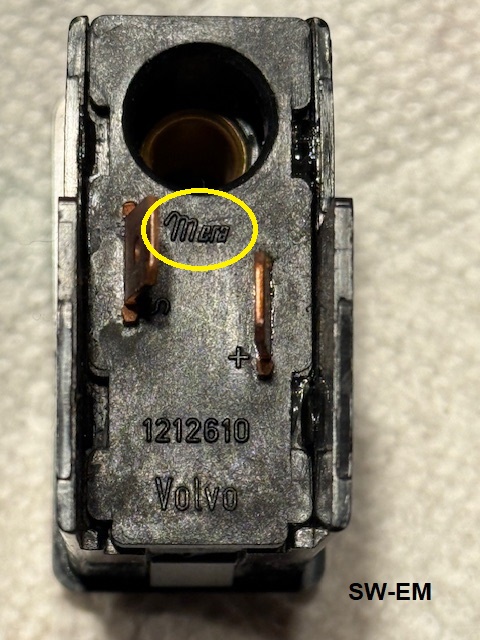
External Inspection: Connections to the Switch are by way of 1/4" push-on connectors. Mera (switch manufacturer(?), 1212610 Volvo are apparent.
After an initial external clean-up with close inspection, the patient revealed that the internals were secured into the outer Housing not with the more typical snap-fit, but with a hollow rollpin(?).
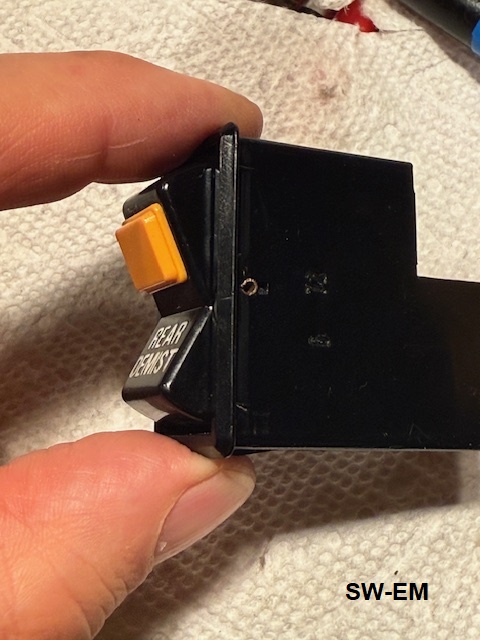
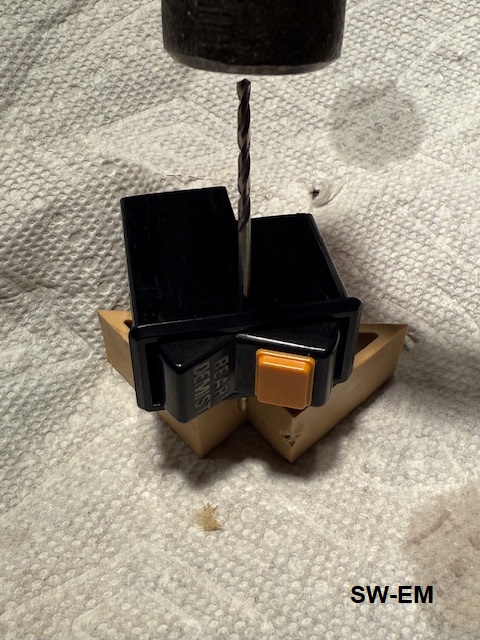
Disassembly: A drillbit of the appropriate size was selected for the job, and after applying a drop of Tri-Flow on both ends of the rollpin, gentle taps on the drillbit were sufficient to move it. [No, I didn't damage the drillbit with hammer blows...more like taps, really!] This allowed removal of the inner assembly from the case, but the inner assy still did not come apart.
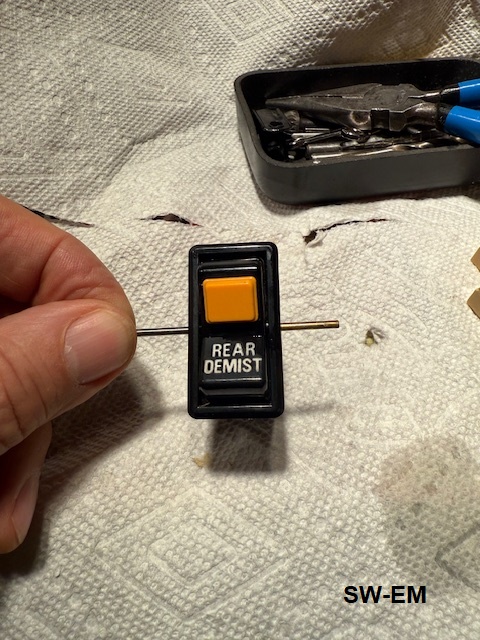
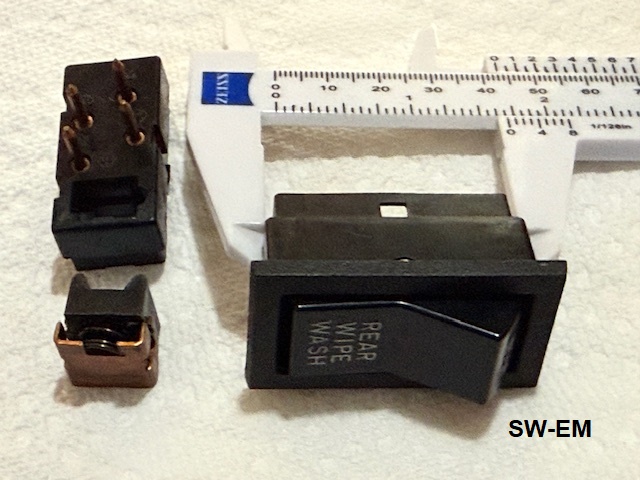
Prying the outer walls of the internal assembly apart, defeated the catches, and allowed it to be disassembled.
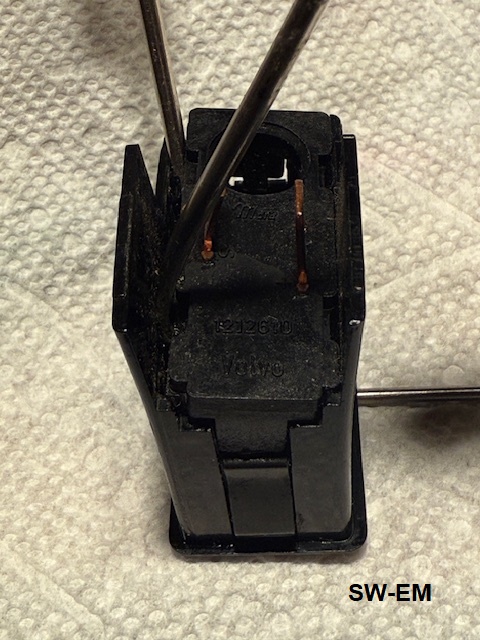
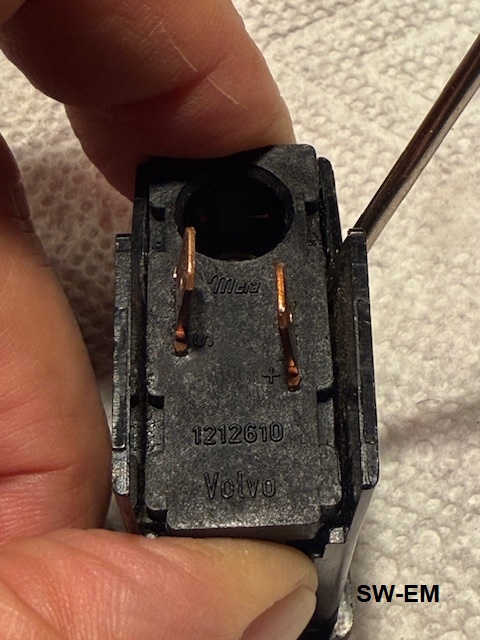
The internal assembly is disassembled from the Housing. There is some dust and debris evident in the "sump" lower area of the Housing. I expect it has nowhere to go in service, so accumulates there.
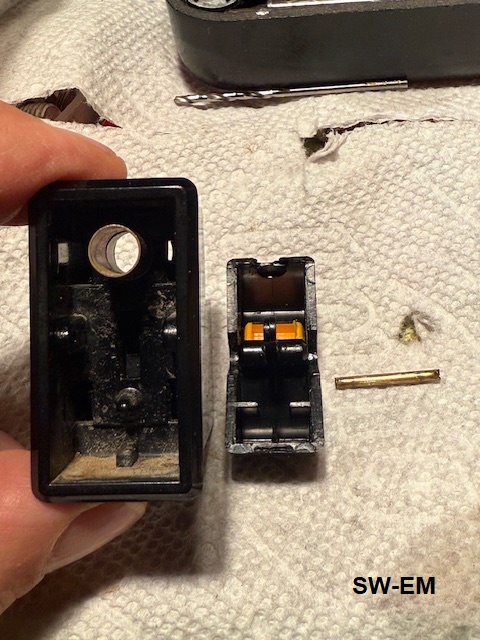
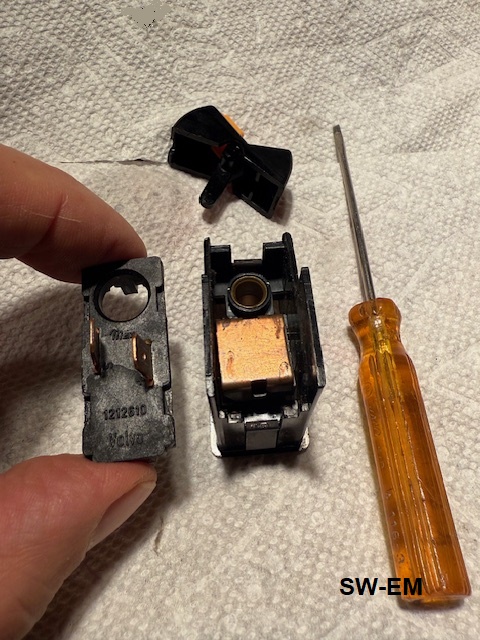
Internal inspection: An internal shuttle with a beefy spring-loaded copper contact plate which is supported by a bakelite(?), maybe thermo-plastic(?) sub-carrier is revealed. The copper plate is bright and shiny, and the current carrying contact areas of the plate exhibits extremely low wear or carbonization, or erosion.
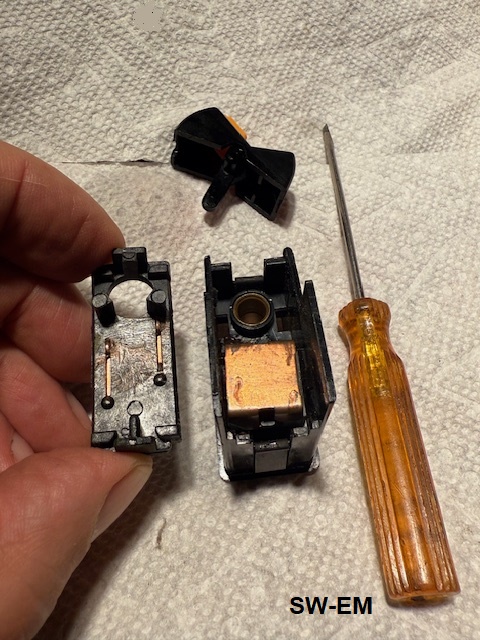
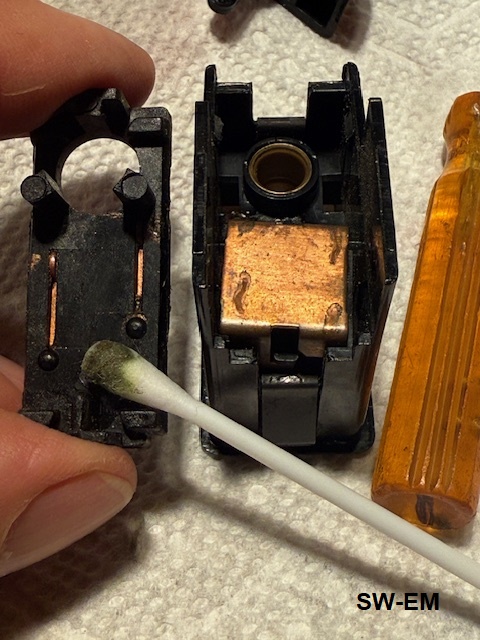
The Contact Shuttle is impressively stout, as is the formed Contact Plate. In the Housing, the slot which the Thumb-actuator pivots in and two detents on either side which lock the switch position once actuated.
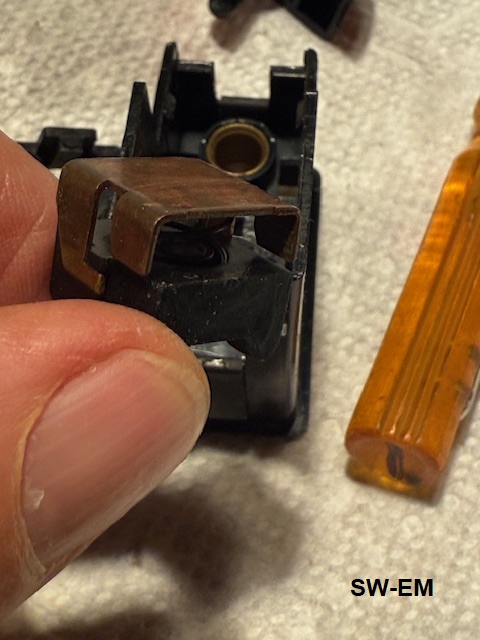
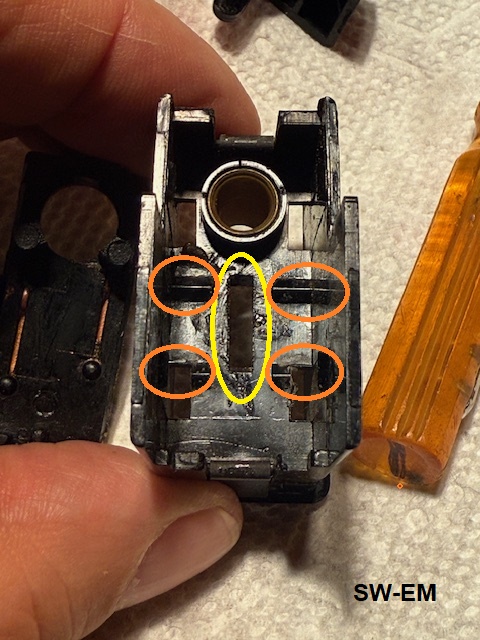
Cleaning of the minimal and deteriorated lube present on internal parts, most of which has turned to a gooey wax, is by isopropyl wetted cotton swabs. This yields perfectly clean minimally worn parts. This switch is a Rear Demist Switch, which doesn't get used so much, so it is in extremely good condition!
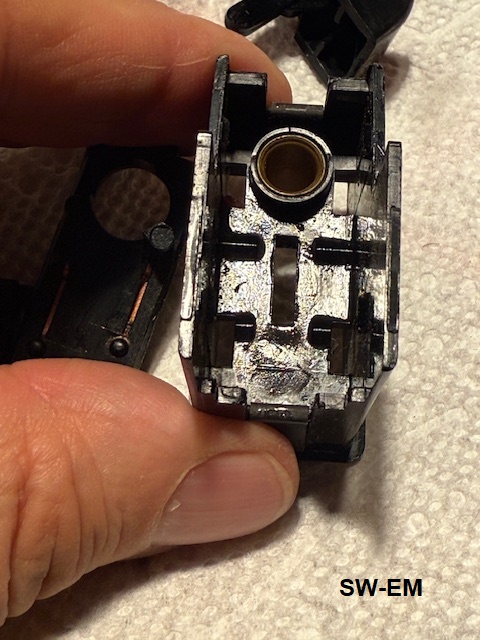
Lubrication: All sliding surfaces, detents and sliding contact points get a microdab of Super-Lube synth-grease before reassembly.
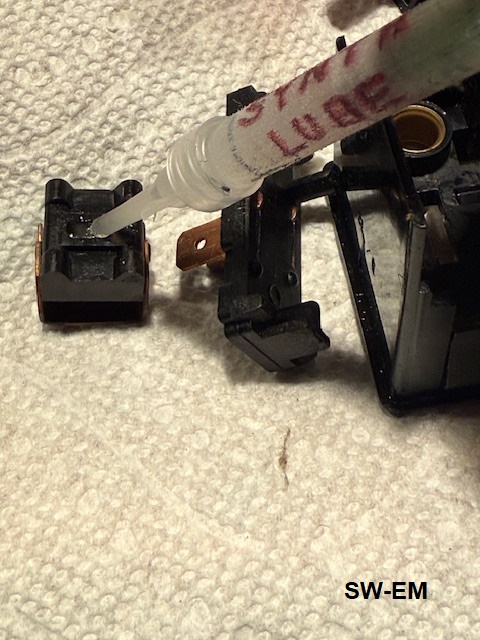
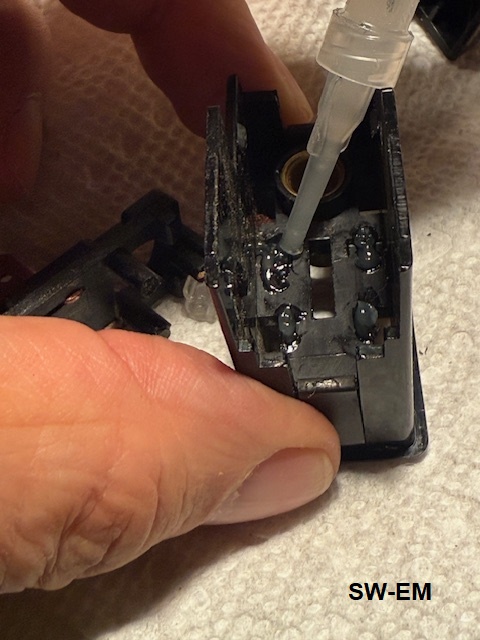
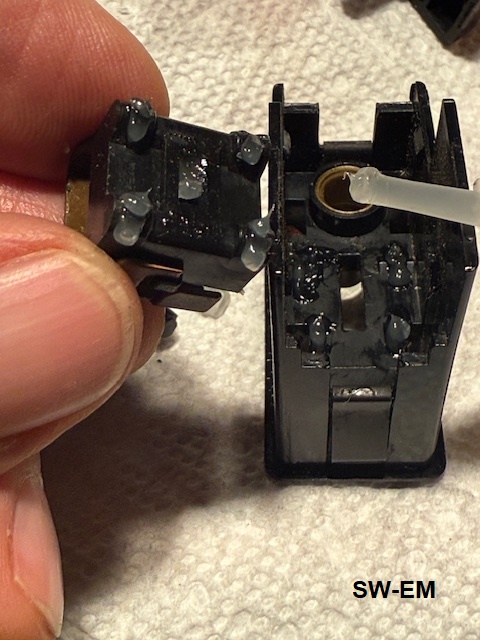
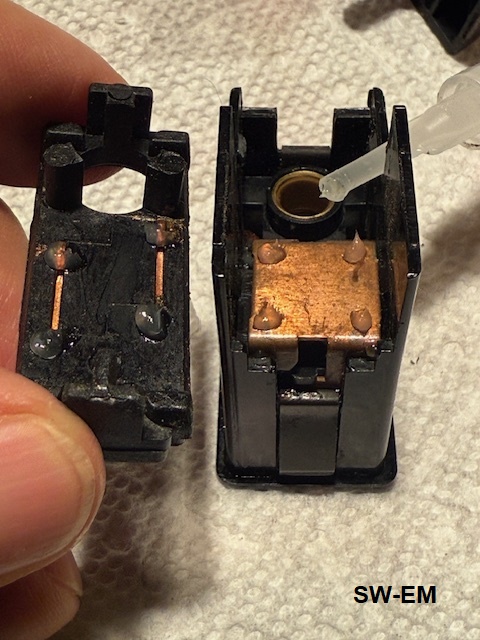
Tailpiece of the Thumb Actuator is lubed, where it fits into its slot.
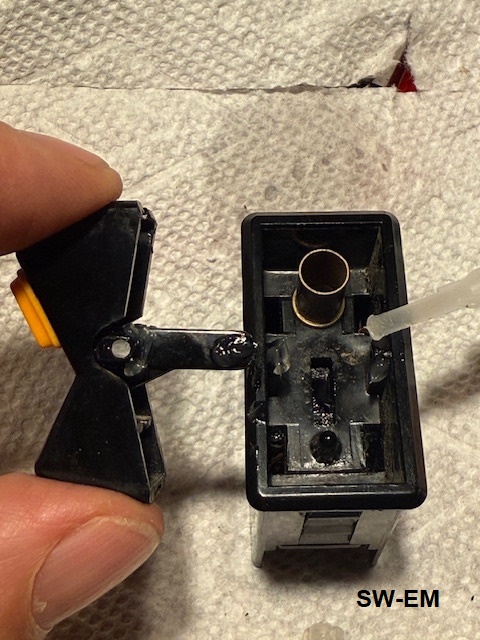
Reassembly: What initially looked like a rollpin, was actually a piece of soft brass tube, so it was slightly deformed when removed...these burrs were cleaned up on an emery board before the pin was reinstalled and simply pushed home.
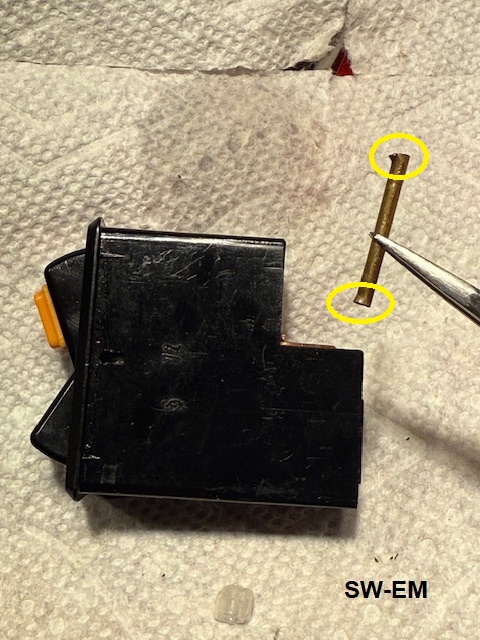
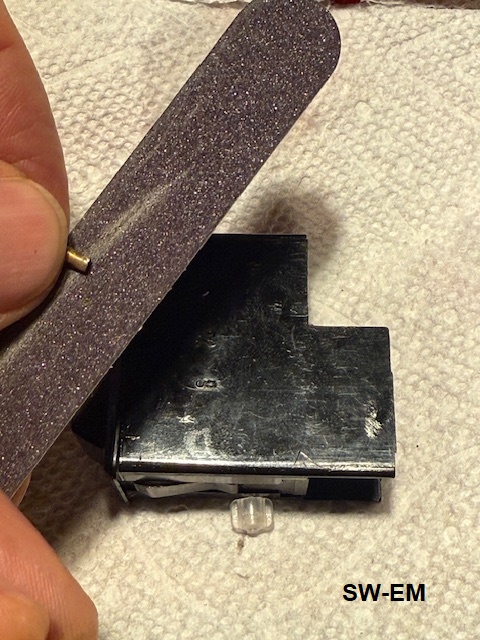
The cleaned-up pin is simply pushed back into place to hold the Switch together.
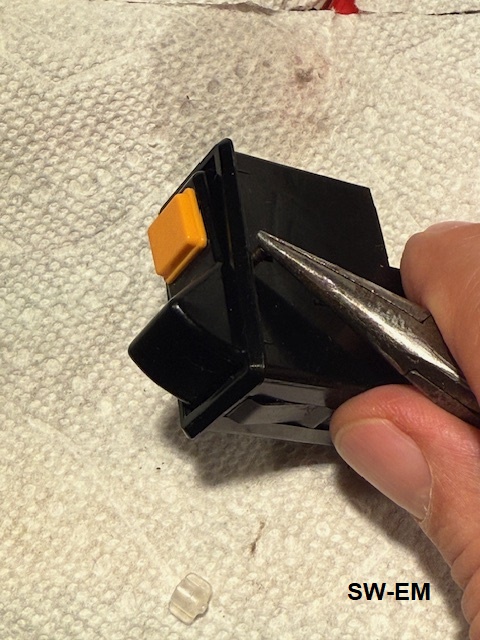
Mechanical/Electrical Checks: I didn't perform any measured force test before the cleaning, refurbishment, lubing, reassembly, but if I had to estimate, the force necessary to activate the switch is now somewhat reduced, and it sounds less snappy...with all the hard edges which snap together being padded by the lube! Electrically, this simple ON/OFF switch works fine still/again. The Super-Lube is easily displaced by the spring loaded contact.
General Impressions and Conclusions: The Mera family of Dashboard Switches as fitted to the '73 1800ES is a very well made family of switches! In fact, the construction looks to be an old school construction, more to satisfy a need for a rocker switch, less to be quickly assemblable and producable on a production line. This family of switches is overbuilt, and undoubtably takes longer to manufacture than more modern designs. That being said, it lends itself nicely to disassembly, refurbishment, and reassembly. I did not observe any areas which I would consider as "weaknesses" or "weak points". The minimal internal lube was unsurprisingly found to be dried and gummed, and was replaced with a synthetic lube which I expect will serve the switch and the operator well for a very long time, and that is about the only recommendation I can make to keep these switches giving reliable duty.
My invitation to forward a mechanically or electrically failed switch for critical evaluation stands. Please contact me!
Comparison with a 240Volvo Rocker Switch:
Dimensions of the '73ES Rocker Switches
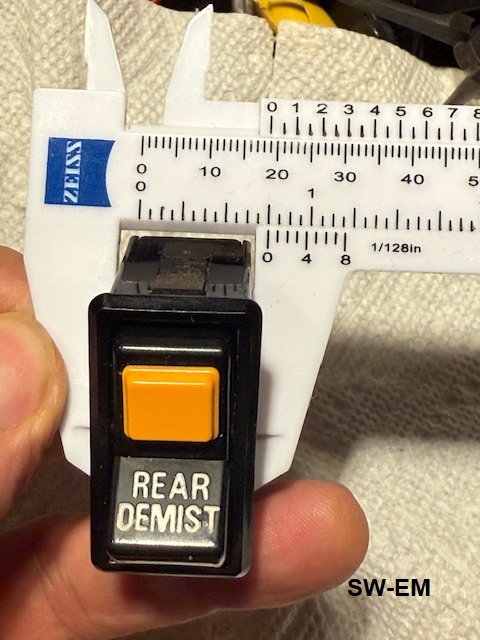
Width: 3/4" (19mm) I expect the hole in the Dashboard
to be about 20mm (I didn't measure it!).
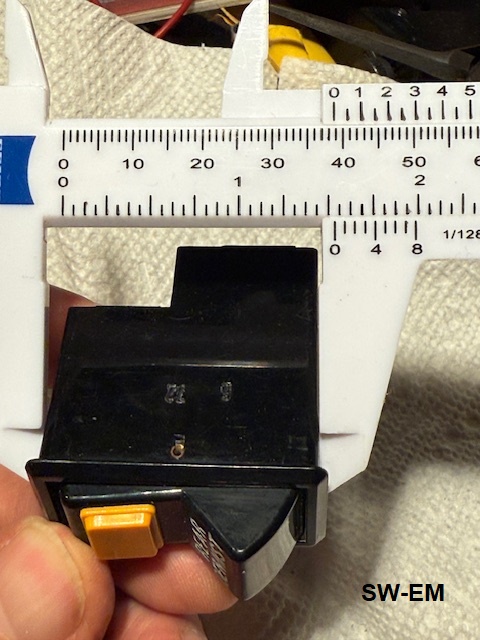
Height: 9/16" (39mm), not counting the retention Springs at either
end. I expect the hole in the Dashboard to be about 40mm (I didn't
measure it!).
A Good Thought, but...
My initial thought from a while ago, was that the Rocker Switches from a Volvo 240 might be the same size as those in the 1800ES, and so could be used as a replacement [I mean how many different automotive Rocker Switch sizes does the world need?], but I was wrong!
From an older posting by me:
"The 1800ES Rocker Switches are similar to switch style also to those used in early 240s shown here, so this might be a source for possible replacements. [Unfortunately, WRONG! Read on! ...and see measurements below!]
UPDATE: There is a current thread on this on subject on the 1800List forum: 1800list@groups.io | ES Rocker switches, does this look like the ones needed? ...where I measured the 240 switch shown here, and found it unfortunately not to be sized correctly to be a direct replacement (or possible parts donor) for the ES switches. I have also ordered a used ES switch of the correct size that I can do some comparative measurements and comparisons. For findings and results of this study, watch this space."

Rocker Switch from a 240 Volvo.
Just for the record:
Measurements of a 240 Rocker Switch:
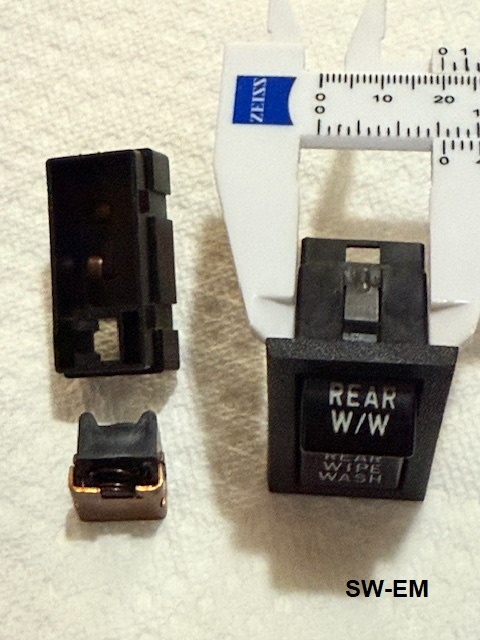
Width: 20mm width, this obviously does not include clearance hole necessary in the
Dashboard, which looks like it would need to be about 21mm.
Height: 43mm again without panel clearance. Hole in Dashboard
looks to be need about 44mm.
-------------------------------
Sidenote: In the Wiring Diagram for the '73 1800ES, the Rocker Switches are also shown differently from the earlier Pull-knob Switches. See: LINK
-------------------------------
Other attempts at a Sport Wagon
-------------------------------
This article is Copyright © 2026. Ronald Kwas. The terms Volvo, and names of other suppliers shown here are used for reference only. I have no affiliation with any of these companies other than to keep their products working for me, help other enthusiasts do the same, and also present my highly opinionated results of the use of their products here. The information presented comes from my own experience and carefully considered opinion (and fruitful little gray cells), and can be used (or not!), or ridiculed and laughed at, or worshipped, at the readers discretion. As with any recipe, your results may vary, and you are, and will always be, in charge of your own knuckles, and future!
You are welcome to use the information here in good health, and for your own non-commercial purposes, but if you reprint or otherwise republish this material, you must give credit to the author or link back to the SW-EM site as the source. If you don’t, you’re just a lazy, scum sucking plagiarist, and the Boston Globe or maybe Harvard wants you! As always, if you can supply corrections, or additional objective information or experience, I will always consider it, and consider working it into the next revision of this article...along with likely the unique metaphor and probably (likely) wise-a** comment, if I can possibly work it in!.